
What have I gotten myself into?
The puppy blues
Jarring juveniles & And teenage torment
Part one
Jamie Flanders CDBC FPPE CFDM
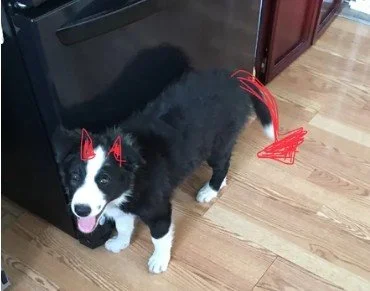
Until recently I have never experienced what it was like to raise a puppy. For the entirety of my career I've given advice to my puppy owning clients on what to do and how to do it. It's good advice, current, effective and when my clients give it their all they've been successful and happy with the outcome. As have I after implementing my own advice. However, I now know that it's easier said than done. 7 months ago I set out to try my own hand at raising a puppy. Armed with 15 years of knowledge and experience from helping my clients through the murky waters of puppy-hood and adolescence, I set out to find the right pup for me. I found a great breeder that I was comfortable with based on the knowledge of what it takes to raise a litter of puppies that will give them the best possible start in life including but not limited to the ability to cope with and recover well from stress. I met the breeder, the puppy's parents, and saw the conditions he was being raised in. I did all my due diligence.
A few weeks in and I was shell shocked, sleep deprived, and stressed out! I thought and still think, why on earth would anyone choose to do this? Quite often I fantasized about taking him back to the breeder. I cried because how could I, a professional dog trainer and behavioral consultant be having such a hard time with this? Perhaps I was more paranoid and worried than most because I knew exactly what comes down the pipe if you don't prepare and take a proactive approach. I think I've done a pretty good job. I've done the best I personally could do, but in-spite of all my robust knowledge, hard work, and daily outings to socialize and habituate to all life has to offer, my puppy still couldn't escape the genetics of his species and I still didn't have enough resources to fully prepare him for what his adolescent brain would put him through.
A question that is always in the air among dog trainers and behaviorists is, why is there so much reactivity in dogs now? I have a big list of reasons that I believe contribute to it that I'll share some time, but right now while in the trenches of my pups adolescence, I can see one huge glaring reason. When a puppy morphs into an adolescent and his brain and body starts folding in on itself and imploding, you are then promoted from puppy owner to behavioral firefighter and if you're not prepared to fight behavioral fires for the next 3 years of your dog's life, your dog will likely join the ranks of the reactive.
A behavioral firefighter is on duty every day until the adolescent dog turns into an adult and maybe even after that if you were not an effective firefighter or as I've discovered, if you were inevitably lacking in your fireproofing which needs to be done during puppy-hood. Your breeder needs to start the fireproofing by choosing healthy and temperamentally sound parents and then providing early neurological stimulation and an enriched environment with just the right amount of stress, just to name a few things. When you bring your pup home you need to finish the fireproofing by gently exposing your pup to the world and build up as many positive associations to potentially scary things as you can. Luckily, It's fairly predictable what stimuli need a thick dose of behavioral retardant put on them; other dogs, the entire spectrum of human types, loud or strange noises, and being handled. These are the things you need to focus on the most, these are the things that will bring you the most stress later on.
You may not have had any control over what happened in your pups first few months of life because you picked him up from a shelter. I don't have the statistical numbers but I'd be willing to bet money the most common age range of dogs in shelters is between 4 months and 3 years of age. A quick google search suggests that I'm not wrong. Being surrendered to a stressful shelter environment during such a sensitive age is so tragic it sickens me to think about it, but I am not at all surprised that dogs in the thick of adolescence are the most commonly surrendered to shelters.
When your pup enters the point in their development where their body and brain begins to change and they turn into a sensitive adolescent who spooks, jumps, and barks with the least bit of provocation you need to be Johnny on the spot because even with the thickest coat of behavioral retardant (gentle exposure, positive associations, habituation and desensitization) the predicable stimuli can still catch fire and you need to be there to put it out when it does. You need to be putting out the fires at the first sign of a spark before it catches and burns for too long becoming habitual and scorching all of your hard work and burning holes where you faltered a bit in your fireproofing preparation.
So, how do you put out the fires?
Learn about emotional regulation, self-regulation, and co-regulation! Puppies and teenage dogs do not have these important skills and will need your help!
Reinforce and re-build positive associations when they fall apart. And they can fall apart!
Continue to gently expose the young dog to the world especially the dreaded triggers. Don’t force them into things when they are showing signs of fear. Let them go at their own pace.
Provide appropriate and not out of proportion consequences for new and annoying behaviors that pup up. Remember “don’t do that, do this instead”. Interrupt and redirect to build good habits over time.
Build skills like recall or a hand target to use as interrupters and redirect them to long lasting distractions like frozen stuffed Toppls.
Manage the hell out of everything! You can prevent bad habits from forming which is MUCH easier than fixing bad habits that have developed.
Never take good and desirable behavior for granted and provide a constant stream of positive reinforcement. Be watching for good choices and good behavior and let them know you like it through treats, play, and praise.
Find your patience and be very careful about losing it on your young impressionable dog while your relationship is still so new. I learned this the hard way and had some lengthy damage control to do regarding baths. My teenage dog rolled in human poop and I got mad. He made a one time assocation between bath time and angry mom.
It's hard work to do right by your pup and you'll have to make many sacrifices including your sleep, beloved routines, and the way you like your home to look. You won’t do everything perfect, mistakes will happen. You may come out the other end a little singed, have a few extra gray hairs and face wrinkles but it will have been worth it because you'll be able to enjoy the fruits of your labor with your little buddy for the rest of his life and he'll have a happier more enriched quality of life because of it.
Good luck and I'll see you on the other side.